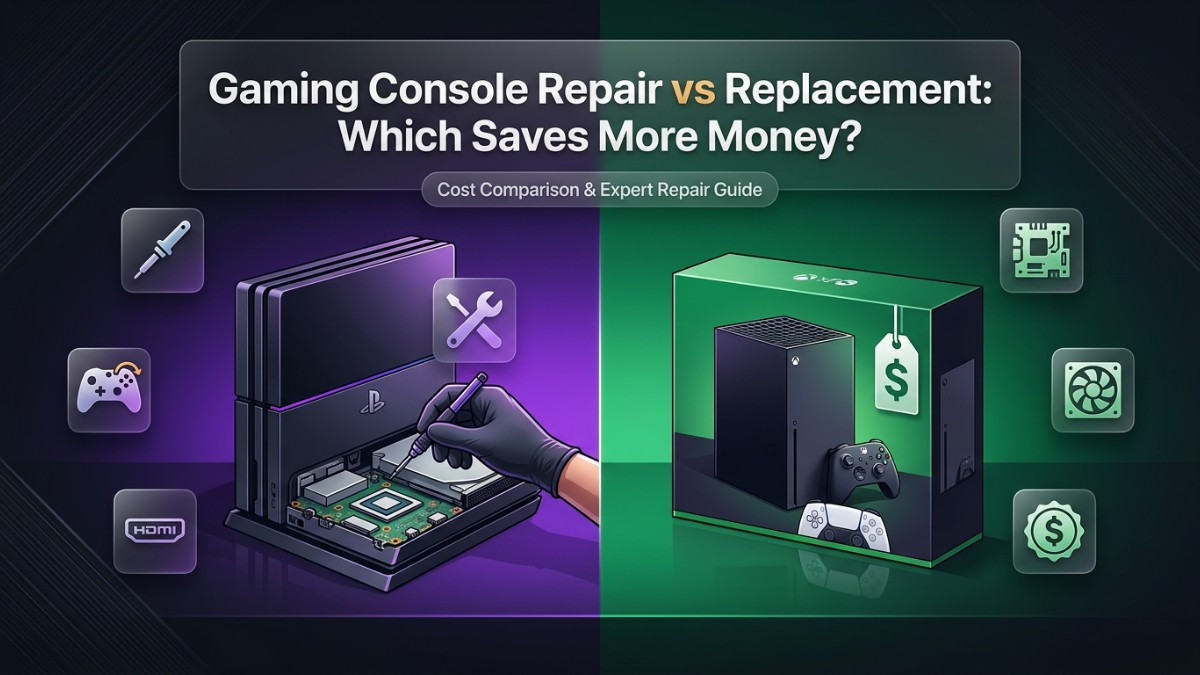
A gaming console breaking down is never a welcome event. Whether it is a PlayStation 5 that suddenly displays the blue light of death, an Xbox Series X that refuses to power on, or a Nintendo Switch with a screen that stopped responding, the immediate question every gamer faces is the same: should I repair it or replace it?
That question sounds simple. The answer is anything but.
The decision between gaming console repair and replacement involves more than just looking at a price tag. It requires a clear understanding of what is actually wrong with the device, what a repair will realistically cost, how much life the repaired console is likely to have, and what the genuine cost of replacement looks like when all the associated expenses are factored in. The answer varies depending on the console model, the nature of the fault, the age of the device, and whether you choose a professional console repair service or attempt the work yourself.
This guide walks through everything you need to know to make that decision confidently. From the most common gaming console problems and their repair costs to a detailed comparison of repair versus replacement across major console platforms, this article gives you the real numbers and expert perspective you need — without the guesswork.
True Cost of Replacing a Gaming Console
Before evaluating whether repair makes financial sense, it is essential to understand what replacement actually costs in full — not just the sticker price of the new device. Most people instinctively compare a repair quote against the retail price of a new console, but this comparison is incomplete and frequently misleading.
The retail price of a new gaming console is just the beginning. A PlayStation 5 currently retails at approximately $499 for the standard disc edition. An Xbox Series X sits at a similar price point. A Nintendo Switch OLED edition runs around $349. These numbers are significant on their own, but they do not account for the full financial picture of starting over with a new device.
Consider what else comes with the transition to a new console. If your previous system was a PlayStation 4 and you are replacing it with a PlayStation 5, you may face game compatibility limitations that require purchasing new titles. Digital game libraries may not transfer fully depending on the platform and region. Accessories — controllers, headsets, charging docks, and storage expansions — may not be compatible with the new system, adding another layer of unplanned expense. If you purchased games physically, those transfers are relatively straightforward, but digital ecosystems are more complicated.
There is also the question of availability. Supply constraints have eased on most current-generation consoles compared to the post-launch scarcity of 2020 through 2022, but pricing fluctuations, bundle requirements from retailers, and regional availability can all affect what you actually end up paying. A gaming console replacement cost that looks reasonable on paper can balloon when accessories, games, and subscription service transfers are included.
Refurbished gaming consoles represent a middle ground that many consumers overlook. A certified refurbished PlayStation 5 or Xbox Series X from a reputable source can cost $100 to $200 less than a new unit while still carrying a warranty. However, the quality of refurbished consoles varies significantly depending on the source, and not all refurbished units have been subjected to rigorous testing. Understanding the buy refurbished console or repair decision requires careful evaluation of what you are actually getting for the price.
The Real Cost of Gaming Console Repair
On the other side of the equation, gaming console repair costs vary considerably depending on the type of fault, the console model, and where the repair is performed. Understanding these costs is essential to making a genuinely informed decision.
Common repairs on modern gaming consoles cover a wide spectrum of complexity and price. Some issues — such as cleaning a clogged cooling system or replacing thermal paste — are relatively inexpensive and can dramatically improve console performance and longevity. Others — such as a motherboard repair for a gaming console or an HDMI port replacement — are more technically demanding and carry higher labor costs.
The following table provides a general overview of typical repair costs for common console issues across major platforms:
| Repair Type |
PlayStation 5 |
Xbox Series X |
Nintendo Switch |
DIY Possible? |
| HDMI port replacement |
$80 – $150 |
$80 – $150 |
N/A |
No (for most users) |
| Thermal paste replacement |
$30 – $70 |
$30 – $70 |
$25 – $50 |
Possible (with caution) |
| Fan cleaning / replacement |
$40 – $90 |
$40 – $90 |
$30 – $60 |
Possible (with caution) |
| Controller stick drift repair |
$20 – $50 |
$20 – $50 |
$20 – $60 |
Possible (with caution) |
| Power supply repair |
$60 – $130 |
$60 – $130 |
$50 – $100 |
No |
| Disc drive repair |
$70 – $150 |
$70 – $160 |
N/A |
No |
| Motherboard repair |
$100 – $300+ |
$100 – $300+ |
$80 – $250+ |
No |
| Screen replacement (Switch) |
N/A |
N/A |
$80 – $150 |
No |
| Software / firmware restore |
$30 – $60 |
$30 – $60 |
$25 – $50 |
Sometimes |
These figures represent professional service pricing. The cost of parts alone for DIY gaming console repair will be lower, but the risk of causing additional damage must be factored in carefully, particularly for inexperienced technicians working on compact, densely engineered modern hardware.
One critical point that is often overlooked: a professional repair typically includes a diagnostic evaluation, a warranty on the work performed, and accountability if something goes wrong. DIY repairs carry none of those assurances. A repair that goes wrong at home can transform a $100 fix into a $500 replacement — or worse.
The Most Common Gaming Console Problems That Lead to the Repair vs Replacement Decision
Understanding what is wrong with your console is the foundation of any repair-versus-replacement analysis. Not all console faults are equal in terms of repairability, cost, or impact on the console's long-term viability.
Overheating and Cooling System Failures
Console overheating repair is one of the most frequently requested services at any console repair shop, and for good reason. Modern gaming consoles generate significant amounts of heat during operation. The PlayStation 5 and Xbox Series X both run powerful processors and graphics units that require efficient cooling to operate safely. When the cooling system — the fan, the heat sink, or the thermal compound — becomes degraded or blocked, the console throttles its performance and, if overheating becomes severe enough, shuts down automatically to prevent damage.
The most common cause of console overheating is dust accumulation inside the ventilation system. Over months and years of use, dust builds up around the fan blades, across the heat sink fins, and on the internal surfaces that direct airflow. This insulation effect reduces the system's ability to dissipate heat, causing internal temperatures to rise progressively.
The fix for dust-related overheating is a thorough internal cleaning combined with a thermal paste replacement on the processor. Thermal paste — the compound that sits between the processor and the heat sink to maximize heat transfer — degrades over time. On the PlayStation 4, Sony's use of a specific thermal compound led to widespread reports of consoles running hot after two or three years of use. Replacing the thermal paste as part of a broader console fan repair and cleaning service can extend a console's useful life by several years at a fraction of the replacement cost.
If you frequently notice your console running loudly with the fan at maximum speed, shutting down unexpectedly during intensive games, or feeling excessively warm around the ventilation vents, these are strong indicators that a cooling maintenance service is overdue. Addressing the issue early prevents it from progressing into more expensive damage.
HDMI Port Damage
The HDMI port is one of the most physically vulnerable components on any gaming console. It is subject to repeated mechanical stress from cable insertion and removal, and a single incident of a cable being pulled at an angle or a console being knocked while a cable is connected can damage or dislodge the port.
A ps5 hdmi port repair is one of the most commonly searched console repair services online, and with good reason — the PlayStation 5's HDMI port, while sturdy, sits in a position that makes it susceptible to damage from careless cable handling. A damaged HDMI port can cause complete loss of video output, intermittent signal loss, screen flickering, or distorted visuals depending on the extent of the damage.
The repair itself involves desoldering the damaged port from the console's mainboard and soldering a replacement port in its place. This requires precision soldering skills and appropriate equipment. It is not a repair suitable for untrained hands. However, in the hands of a skilled technician, an hdmi port replacement for a gaming console is a well-established and highly successful repair with a strong track record of restoring full functionality. The cost — typically $80 to $150 — is substantially less than the cost of a new console, making this a clear case where repair wins the financial comparison decisively.
Controller Stick Drift
Controller stick drift is one of the most universally frustrating problems in gaming. It occurs when the analog sticks on a controller begin registering movement input even when the player is not touching them, causing erratic character movement, camera drift, or unintended menu navigation. Nintendo Switch Joy-Con controllers became particularly notorious for this issue, resulting in a class-action lawsuit in the United States. PlayStation's DualSense and Xbox's controllers are not immune to the problem either.
Stick drift is caused by wear on the potentiometer contacts inside the analog stick module. Over time, the conductive surfaces that track stick position wear down or become contaminated, causing inaccurate readings. The repair involves either cleaning the potentiometer contacts with isopropyl alcohol — which is sometimes effective for early-stage drift — or replacing the analog stick module entirely.
A controller stick drift repair is one area where a careful DIY approach is more accessible than most console repairs, provided you have the right tools and follow reliable disassembly guides. Replacement analog stick modules are widely available and reasonably priced. However, if the controller has multiple issues or if the drift has progressed to the point where cleaning is unlikely to help, professional repair is more reliable and cost-effective in the long run.
Power Supply Failures
A console that will not power on, powers on inconsistently, or shuts off unexpectedly without overheating may be experiencing a console power supply repair need. The power supply unit regulates the electrical power delivered to all components inside the console. When it fails — through component degradation, surge damage, or manufacturing defects — the effects range from complete power failure to erratic behavior under load.
Power supply issues are particularly common in older PlayStation and Xbox consoles that have been in use for many years. The PlayStation 3 and original Xbox One models developed reputations for power-related failures as they aged. On modern consoles, power supply problems are less common but not unheard of, especially in consoles that have experienced power surges or have been operated in environments with unstable power delivery.
Diagnosing a power supply issue requires proper testing equipment. A technician will check whether the power supply is delivering the correct voltages to the console's internal components. In many cases, the power supply can be repaired by replacing specific internal components. In others, a full unit replacement is more practical. Either way, this is firmly in the territory of professional console repair service — it is not a repair that can be safely or effectively attempted at home.
Motherboard and Internal Circuit Failures
Motherboard repair for a gaming console represents the most serious and expensive category of repair. The motherboard is the central circuit board that connects and coordinates every component in the console. Faults at the motherboard level can be caused by physical damage, liquid exposure, manufacturing defects, power surges, or progressive component wear.
Symptoms of motherboard-level issues include the console failing to boot past an initial screen, error codes that persist after all other troubleshooting steps, complete failure to power on despite a functional power supply, or sporadic and unexplainable behavior during operation.
Motherboard repair at this level requires advanced microsoldering skills and diagnostic equipment that is far beyond the reach of typical home repair attempts. Experienced technicians can often resolve specific IC failures, BGA chip issues, or trace damage on console motherboards using specialized equipment. The cost reflects the complexity of the work, ranging from $100 to over $300 depending on the fault. For a modern console that retails at $500, a successful motherboard repair at even the higher end of that range still represents a meaningful financial saving compared to replacement — particularly when the console contains a valuable digital game library.
PlayStation Repair vs Replacement: A Detailed Look
The decision to repair or replace a PlayStation console depends heavily on which generation of console is in question. The calculus looks very different for a PlayStation 4 compared to a PlayStation 5.
A PlayStation 4, particularly an older launch model or PS4 Slim, has a current market value that ranges from roughly $100 to $200 on the used market depending on condition and bundled accessories. If a PS4 requires a repair that costs more than $150, the economic argument for repair becomes weak — particularly since a PS4 Pro in good condition can be purchased used for a comparable price. However, if the repair is straightforward — cleaning and thermal paste replacement for an overheating console, for example — spending $50 to $70 to extend the life of a functional system is entirely reasonable.
The repair or replace ps5 question, by contrast, almost always tilts toward repair for common issues. A PlayStation 5 retails at $499 new and holds a strong resale value. Most common PS5 faults — HDMI port damage, overheating, disc drive issues — cost significantly less to repair than to replace the console. Unless the PS5's motherboard has suffered catastrophic damage, a gaming console repair is the financially sound choice in the vast majority of scenarios.
| PS5 Issue |
Repair Cost |
New Console Cost |
Verdict |
| HDMI port damage |
$80 – $150 |
$499 |
Repair |
| Overheating / thermal paste |
$40 – $80 |
$499 |
Repair |
| Disc drive failure |
$80 – $150 |
$499 |
Repair |
| Controller drift |
$20 – $50 |
$69 (controller) |
Repair |
| Motherboard failure |
$150 – $300+ |
$499 |
Evaluate case-by-case |
| Power supply failure |
$70 – $130 |
$499 |
Repair |
Xbox Repair vs Buying New: How the Numbers Compare
The xbox repair vs buying new comparison follows a similar logic to the PlayStation analysis but with a few notable differences. Xbox consoles tend to have slightly different failure patterns, and Microsoft's repair program — while available — can be expensive and slow for out-of-warranty devices.
The Xbox Series X retails at approximately $499. Common issues include HDMI port damage, fan and cooling problems, and power supply failures. An xbox series x repair service for HDMI port issues typically runs $80 to $150, making repair the obvious financial choice. For overheating issues, a cleaning and thermal paste service in the $50 to $80 range can restore full performance and extend the console's operational life considerably.
One factor that makes Xbox repair particularly compelling is the backward compatibility ecosystem. An Xbox Series X can play games spanning four generations of Xbox hardware. The digital and physical game libraries accumulated over years of Xbox ownership carry genuine value that would be sacrificed — or require repurchasing — if switching platforms. Repairing the existing console preserves that library intact.
For older Xbox One models, the repair-versus-replace calculation again depends on the specific fault and the cost of repair relative to the console's current market value. An Xbox One S in good condition is worth roughly $80 to $150 used. Major repairs on older Xbox models that approach or exceed that value are difficult to justify financially unless there are specific reasons to preserve that particular unit.
Nintendo Switch Repair Cost: Is It Worth Fixing?
The Nintendo Switch occupies a unique position in the repair-versus-replace discussion because it functions as both a home console and a portable device. This dual nature exposes it to a wider range of physical risks than a stationary console — it gets dropped, carried, and used in environments that a PlayStation or Xbox never encounters.
Nintendo switch repair cost for the most common issues — Joy-Con drift, screen damage, and charging port failures — is generally favorable compared to replacement. A new Nintendo Switch OLED retails at $349, while most individual repairs cost well under $150. Screen replacement on a Switch, for example, typically runs $80 to $150 at a professional repair shop, which is substantially less than buying a new unit.
The Joy-Con drift issue deserves special mention. Nintendo has acknowledged the problem and extended its warranty coverage in response to widespread complaints. If your Switch is still within the extended warranty period, Nintendo may repair the Joy-Cons at no charge. If the warranty has expired, third-party repair services offer stick module replacements at competitive prices. Attempting a DIY stick replacement on Joy-Cons is feasible for users with the right tools and sufficient patience, but the extremely small scale of the components makes it more challenging than controller repairs on stationary consoles.
One situation where Switch replacement becomes more compelling than repair is when multiple components have failed simultaneously or when the device has experienced significant physical damage, such as a cracked housing combined with a damaged screen and a malfunctioning Joy-Con rail. At that point, the cumulative repair cost may approach the price of a certified refurbished Switch, making replacement the more practical option.
DIY Console Repair: What Is Safe and What Is Not
The rise of online repair tutorials, affordable tool kits, and accessible parts suppliers has made DIY gaming console repair more accessible than ever. For some common issues, a careful DIY approach can save meaningful money. For others, it can turn a manageable problem into a catastrophic one.
Repairs that are generally accessible for careful DIY attempts:
- External cleaning of vents and fan intakes using compressed air
- Controller stick drift repair using cleaning or module replacement
- Minor software troubleshooting, factory resets, and firmware updates
- Replacing external rubber grips or worn buttons on controllers
Repairs that require professional handling:
- HDMI port replacement on any modern console
- Internal cleaning and thermal paste replacement (accessible to some but risky for beginners)
- Power supply diagnosis and repair
- Motherboard-level work of any kind
- Screen replacement on the Nintendo Switch
- Disc drive replacement or recalibration
The risk calculus for DIY console repair is important to understand clearly. Modern gaming consoles — particularly the PlayStation 5 and Xbox Series X — are engineered with extreme precision. The internal components are compact, the connections are delicate, and the assembly sequences are complex. Opening a console incorrectly can damage ribbon cables, strip proprietary screws, or crack housing components. Proceeding with a repair without proper tools or technique can cause damage that exceeds the original fault in both severity and cost.
For gamers who are genuinely interested in learning console repair and are prepared to invest in proper tools and training, the skills are learnable. But approaching a malfunctioning console as a first-time repair project without research and preparation is a risk that rarely ends well.
| Repair Type |
DIY Risk Level |
Skill Required |
Recommended Approach |
| Vent cleaning (external) |
Very Low |
None |
DIY |
| Controller drift cleaning |
Low |
Basic |
DIY with research |
| Controller stick replacement |
Moderate |
Intermediate |
DIY or professional |
| Thermal paste replacement |
Moderate – High |
Intermediate |
Professional recommended |
| Fan replacement |
Moderate – High |
Intermediate |
Professional recommended |
| HDMI port replacement |
Very High |
Advanced |
Professional only |
| Power supply repair |
Very High |
Advanced |
Professional only |
| Motherboard repair |
Extreme |
Expert |
Professional only |
When Replacement Makes More Sense Than Repair
While the financial argument for repair is compelling in most scenarios, there are genuine situations where replacement is the smarter long-term choice. Knowing when to draw that line is just as important as knowing when to pursue repair.
Replacement becomes more rational when the repair cost exceeds 60 to 70 percent of the console's current market value. This threshold accounts for the remaining useful life of a repaired device versus the fresh start a replacement provides. A console that requires a $350 repair when the device is worth $400 used is technically worth repairing, but not by a comfortable margin. A console requiring a $350 repair when it is worth $200 used is not a financially sound repair investment.
Age is another critical factor. Gaming console lifespan varies by model and usage intensity, but most consoles have a practical operational life of seven to ten years under normal conditions. A console that is approaching the end of its generation cycle — particularly when a successor has already been released — has diminishing long-term value even after a successful repair. Spending $150 to repair a PlayStation 3 in 2025, for example, is difficult to justify unless the user has specific reasons to maintain that platform.
Recurrent failures also tip the scale toward replacement. A console that has required multiple significant repairs over a short period is demonstrating systemic reliability issues that are unlikely to resolve with additional repairs. Continuing to invest in a device with a pattern of failure is a cycle that becomes financially and practically unsustainable.
Finally, availability of parts is a practical constraint. Repair old gaming console attempts become increasingly difficult as manufacturers discontinue parts and third-party suppliers exhaust their inventory. When genuine or compatible replacement parts are no longer available, the repair path closes regardless of cost considerations.
How to Choose the Right Console Repair Shop
The quality of a console repair is only as good as the technician performing it. Selecting the right game console repair near me option is not simply a matter of finding the cheapest available service — it requires evaluating the shop's competence, transparency, and accountability.
Look for a console repair shop that offers a diagnostic service before committing to a repair. A reputable shop will assess your console, identify the fault accurately, provide a clear and itemized quote, and give you the option to decline the repair if the cost does not meet your expectations. Shops that quote a flat repair price without proper diagnosis are a red flag.
Warranty coverage on repairs is another essential criterion. A confident and capable repair shop stands behind its work with a warranty on both parts and labor — typically ranging from 30 days to 90 days for most repairs. This warranty protects you if the same issue recurs shortly after the repair, ensuring that you are not paying twice for the same problem.
Technician qualifications matter. Look for shops that can demonstrate experience with the specific console you own, whether it is a PlayStation, Xbox, or Nintendo system. Reviews from other customers — particularly those who had the same or similar repairs performed — provide valuable insight into a shop's reliability and quality of work.
Turnaround time is also a practical consideration. A reliable console repair service should be able to complete most common repairs within one to three business days. For simpler repairs like cleaning or controller work, same-day service is often available. Extended repair times without clear communication are a sign of organizational issues that may affect the quality of your experience.
| Evaluation Criterion |
What to Look For |
Red Flags |
| Diagnostic process |
Free or low-cost assessment before repair |
Flat-rate quotes without diagnosis |
| Warranty |
30 – 90 days on parts and labor |
No warranty offered |
| Experience |
Verifiable experience with your console model |
Vague or unspecific claims |
| Turnaround time |
1 – 3 days for most repairs |
Weeks without explanation |
| Pricing transparency |
Itemized quotes with parts and labor |
Hidden fees after repair |
| Customer reviews |
Consistent positive feedback |
Multiple unresolved complaints |
Gaming Console Maintenance Tips to Avoid Costly Repairs
Preventing problems is always more cost-effective than solving them. Consistent gaming console maintenance tips, followed as part of regular ownership habits, can meaningfully extend the life of your console and reduce the likelihood of encountering the failures discussed throughout this article.
Positioning matters more than most users realize. Consoles need adequate airflow to function safely. Placing a console inside a closed entertainment cabinet, directly against a wall, or on carpet that restricts ventilation is one of the most common causes of premature overheating. Always ensure that at least six inches of clear space surrounds the console's ventilation areas, and position the unit on a hard, flat surface that does not restrict airflow from below.
Regular external cleaning is simple and effective. Use compressed air to clear dust from external vents every three to six months, depending on how dusty your environment tends to be. This quick maintenance step prevents the gradual buildup that leads to thermal issues and, ultimately, to more expensive internal cleaning requirements.
Surge protection is an investment that pays for itself. Power surges — caused by lightning strikes, grid fluctuations, or appliance cycling on shared circuits — can damage sensitive console electronics in ways that are not always immediately apparent. A quality surge protector with appropriate joule ratings is a modest expense that can prevent power-related console failures.
Handle cables and ports with care. The HDMI port, USB ports, and power connector on every console are mechanical components that wear with use. Always connect and disconnect cables straight and gently, without applying sideways force. Avoid leaving cables connected to a console that is being moved or transported, as this puts lateral stress on the port housing.
Store controllers properly. Controllers left on hard surfaces or dropped repeatedly experience wear on their analog sticks, bumpers, and triggers. Controller cases and proper storage reduce the mechanical wear that leads to stick drift and button failures.
Repair vs Replacement: A Consolidated Cost Comparison
To bring all of the analysis together in one place, the following table provides a consolidated view of the repair-versus-replacement decision across common console models and fault scenarios:
| Console |
Common Fault |
Repair Cost |
Replacement Cost (New) |
Recommended Action |
| PS5 |
HDMI port damage |
$80 – $150 |
$499 |
Repair |
| PS5 |
Overheating |
$40 – $80 |
$499 |
Repair |
| PS5 |
Motherboard failure |
$150 – $300+ |
$499 |
Evaluate |
| Xbox Series X |
HDMI port damage |
$80 – $150 |
$499 |
Repair |
| Xbox Series X |
Fan / cooling |
$50 – $90 |
$499 |
Repair |
| Xbox Series X |
Power supply |
$70 – $130 |
$499 |
Repair |
| Nintendo Switch |
Screen damage |
$80 – $150 |
$349 (OLED) |
Repair |
| Nintendo Switch |
Joy-Con drift |
$20 – $60 |
$79 (Joy-Con pair) |
Repair |
| PlayStation 4 |
Overheating |
$40 – $70 |
$150 – $200 (used) |
Repair |
| PlayStation 4 |
HDMI port |
$70 – $120 |
$150 – $200 (used) |
Evaluate |
| Xbox One |
Power supply |
$50 – $100 |
$80 – $150 (used) |
Evaluate |
| Xbox One |
Motherboard |
$100 – $250 |
$80 – $150 (used) |
Replace |
The pattern that emerges from this data is consistent: for current-generation consoles with high replacement costs, repair is almost always the more financially sound choice for any single, well-defined fault. For older consoles with lower market values, the decision becomes more nuanced and depends heavily on the specific fault and its repair cost relative to the device's worth.
Environmental Case for Repairing Rather Than Replacing
The financial argument for console repair is strong. The environmental argument is equally compelling, and it is one that deserves consideration alongside the economic analysis.
Manufacturing a new gaming console is a resource-intensive process. Modern consoles contain rare earth elements, precious metals, and complex polymers whose extraction and processing carry significant environmental costs. When a console is discarded and replaced, those manufacturing costs are incurred again for the replacement unit, while the discarded console contributes to the growing global problem of electronic waste.
Choosing repair over replacement extends the useful life of an existing device, deferring — and in many cases entirely eliminating — the need for a new unit. A console that lasts ten years instead of five reduces its effective environmental footprint significantly. An affordable console repair that adds two or three years of functional life to a device is, in that sense, both financially and environmentally responsible.
This perspective also reframes the repair-versus-replace decision for consumers who prioritize sustainability. Even in cases where the financial difference between repairing and replacing is relatively modest, the environmental benefit of repair adds a dimension of value that the pure cost comparison does not capture.
Professional Console Repair vs Manufacturer Repair Programs
Consumers evaluating repair options typically have two primary avenues: third-party professional repair shops and the console manufacturer's own repair program. Understanding the differences between these options is important for setting realistic expectations around cost, turnaround time, and coverage.
Manufacturer repair programs — such as Sony's PlayStation Repair Service or Microsoft's Xbox Support repair process — offer the assurance of original parts and factory-trained technicians. However, they also tend to charge premium prices, have longer turnaround times due to shipping and processing logistics, and may decline to repair consoles that have been previously opened by a third party. For consoles under warranty, manufacturer repair is typically the first and most cost-effective option. For out-of-warranty consoles, the cost advantage shifts toward reputable third-party shops.
Third-party professional repair services offer greater flexibility, faster turnaround, and often more competitive pricing. A local console repair shop can perform most common repairs within one to three days, compared to the one to three weeks that manufacturer mail-in programs typically require. Quality third-party shops use high-grade compatible parts and provide their own repair warranties, offering a level of service accountability that is comparable to manufacturer programs for most repair types.
The exception to this comparison is when proprietary parts or firmware-level repairs are required. Some console manufacturers — Nintendo in particular — have implemented software-based component pairing that limits the functionality of replacement parts installed outside the official repair channel. A reputable repair technician will be transparent about these limitations and help you understand how they affect your specific repair scenario.
Your Console Deserves Expert Care — Get It Repaired Today
Living without your gaming console is frustrating, especially when the difference between playing and waiting comes down to a repair that can be handled quickly and professionally. At Phone Repair Point Laurel, experienced technicians handle gaming console repairs with the same precision and care applied to every device that comes through the door — from a cracked Nintendo Switch screen to a complex PlayStation 5 HDMI port replacement.
Every repair starts with a thorough diagnostic evaluation so you know exactly what is wrong and what it will cost before any work begins. Most common console repairs are completed the same day or within 24 hours, minimizing the time you spend away from your gaming setup. All repairs come backed by a warranty on both parts and labor, so you can trust that the fix is built to last.
The team at Phone Repair Point Laurel has hands-on experience with PlayStation, Xbox, and Nintendo consoles across multiple generations. Whether you are dealing with overheating, a damaged port, controller drift, or a console that refuses to power on, the solution is closer than you think.
Walk in at any time, call ahead to describe your issue and get a preliminary assessment, or book online for a convenient appointment that works with your schedule. Do not spend another day without your console when a fast, reliable, and affordable repair is available right now.
Phone Repair Point Laurel
Montrose Ave,
Laurel, MD 20707, United States
(240) 554-0099
https://phonerepairpoint.com/
Frequently Asked Questions
Is it worth repairing a gaming console that is several years old?
Whether gaming console repair makes sense for an older device depends on the specific fault and the console's current market value. As a general guideline, if the repair cost is less than 50 to 60 percent of what a comparable used console would cost, repair is the more financially sound choice. For older consoles with lower market values and expensive faults, replacement or purchasing a refurbished unit may be more practical.
How long does a typical gaming console repair take at a professional shop?
Most common repairs — including HDMI port replacement, overheating service, and controller stick drift repair — are completed within one to three business days at a professional console repair shop. Simpler services such as external cleaning or software troubleshooting can often be completed the same day. Complex repairs such as motherboard-level work may take longer depending on parts availability and the extent of the fault.
Can a console that has been opened by a third-party repair shop still be repaired by the manufacturer?
This depends on the manufacturer's policy, which varies by brand and region. Sony and Microsoft will generally void the manufacturer's warranty if the console has been opened by an unauthorized party. However, if the console is already out of warranty, a prior third-party repair does not necessarily prevent the manufacturer from accepting a repair request — though some proprietary component pairing on Nintendo devices can create limitations for certain types of repairs.
What is the most cost-effective repair for a PlayStation 5 compared to buying new?
For most common PlayStation 5 faults — HDMI port damage, overheating, disc drive failure, and power supply issues — professional repair costs between $40 and $150, compared to the $499 retail price of a new console. This makes repair the clear cost-effective choice for the majority of PS5 issues. A repair or replace ps5 decision only becomes genuinely difficult when the fault involves catastrophic motherboard damage with repair costs approaching $300 or more.
Is Joy-Con drift on a Nintendo Switch something I can fix myself?
Joy-Con drift can sometimes be addressed at home through careful cleaning of the analog stick contacts with isopropyl alcohol, which is effective for early-stage drift. For more advanced drift caused by physical wear on the potentiometer, a full stick module replacement is needed. This DIY repair is technically feasible for users with the right tools and a steady hand, but the small scale of the components makes it challenging. Professional nintendo console repair is a reliable and affordable alternative if DIY is not comfortable.
Do console repair shops offer warranties on their work?
Reputable professional console repair services do provide warranties on both parts and labor, typically covering 30 to 90 days after the repair is completed. This warranty protects you if the same issue recurs within the covered period, ensuring that you are not charged again for a problem that was not fully resolved. Always ask about warranty coverage before authorizing a repair, and choose a shop that stands behind its work with clear, written warranty terms.